
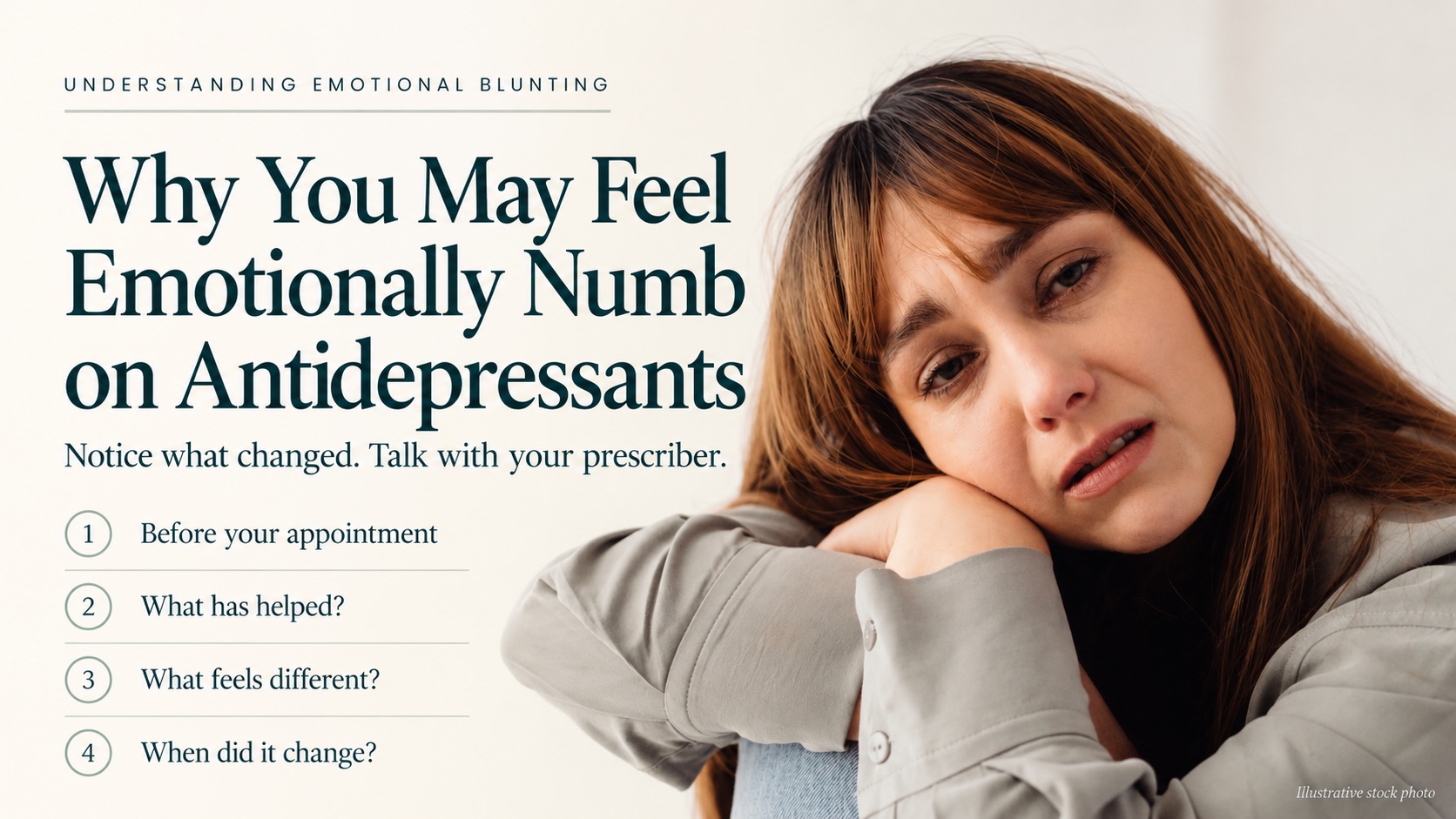
Feeling emotionally numb while taking an antidepressant may involve medication effects, depression symptoms that have not fully improved, or both. The timing of the change can help your prescriber investigate, but it cannot establish the cause by itself. A clinical review discusses why understanding the individual experience matters.
Perhaps treatment has eased your sadness or anxiety, but good news brings little excitement. You spend time with someone you love and still feel distant. These changes are worth discussing, even when treatment has helped in other ways.
Tell your prescriber what feels different and what has improved. Do not stop, skip, or change your medication to test the cause yourself. NIMH recommends working with your prescriber before stopping prescribed medication.
What does emotional blunting feel like?
Emotional blunting describes a reduction in the intensity of both pleasant and unpleasant emotions. In an Oxford qualitative study, people taking SSRIs described reduced enjoyment, affection, excitement, and emotional responses to upsetting events. Their accounts describe lived experiences, but do not establish medication as the cause in every case.
You might describe the change as:
- Feeling less excited about activities you usually enjoy.
- Feeling less emotionally connected during conversations.
- Reacting less strongly to good or upsetting news.
- Recognizing that something matters without feeling your usual response.
You do not need the perfect medical term before asking for help. An everyday example gives your prescriber something concrete to discuss.
How is emotional flatness different from relief?
Consider whether distress has become easier to manage while enjoyment and connection remain. Then describe any changes you find unwelcome.
For example, “I worry less at work, but I also don’t look forward to seeing my friends” explains both a benefit and a concern. This is an illustrative example, not a patient quotation.
People can experience reduced emotional intensity differently. Some participants in the Oxford study welcomed relief from distress, while others described emotional changes that interfered with daily life.
How common is emotional blunting on antidepressants?
A 2017 internet survey reported emotional blunting in 310 of 669 adults with depression taking a single antidepressant, approximately 46%. Higher blunting scores were associated with more depressive symptoms.
That figure describes the surveyed group. It does not mean that everyone starting an antidepressant has a 46% chance of developing emotional numbness. Because the study relied on self-reports and was observational, it could not separate medication effects from the effects of depression.
What does research tell us about the cause?
Different study designs provide different pieces of the explanation.
A study in healthy volunteers found a possible medication effect. In a 2023 controlled study, 66 volunteers received escitalopram or a placebo for at least 21 days. Escitalopram reduced sensitivity to feedback on two learning tasks. However, the participants did not have depression, and the findings do not directly measure emotional numbness in everyday life.
Short-term depression trials found improvement on average. A 2022 trial analysis examined three eight-week randomized trials and found that emotional responsiveness improved across treatment groups. However, the analysis used a single “inability to feel” item and could not establish what happens during long-term treatment.
These findings address different populations and outcomes. Together, they support taking your experience seriously without assuming that medication must be responsible.
Could it be depression that hasn’t fully improved?
Depression symptoms can include an empty mood, reduced enjoyment, low energy, withdrawal, and difficulty concentrating. Feeling less sad does not necessarily mean every symptom has resolved.
Anhedonia means reduced interest or pleasure. Emotional blunting refers more broadly to muted emotional responses, including unpleasant emotions. A review of these differences explains that the experiences can overlap. These descriptions cannot establish a diagnosis on their own.
Before your appointment, consider:
- Was numbness present before treatment?
- When did you first notice a change?
- Did it follow a medication or dose change?
- Have sleep, energy, concentration, or enjoyment changed too?
Use these questions to organize your observations, not to decide the cause yourself.
What if my depression score has improved?
Tell your prescriber about feeling flat even if your depression score is lower.
The PHQ-9 questionnaire assesses depression symptoms and can help monitor their severity. It is not a specific emotional-blunting questionnaire or a test of whether medication caused a symptom. Discuss your experience alongside the score.
Can this happen while taking Lexapro or Zoloft?
Escitalopram, sold as Lexapro, and sertraline, sold as Zoloft, are selective serotonin reuptake inhibitors, or SSRIs.
People taking both medicines reported emotional blunting in the 2017 survey. However, the study’s size and design limit comparisons between individual antidepressants. It does not establish which medicine would be best for you.
If you take either medicine, report emotional changes alongside the benefits you have noticed. MedlinePlus advises against stopping either without discussing it with your doctor because abrupt stopping can cause withdrawal symptoms. Its guidance covers both stopping escitalopram and stopping sertraline.
What should you bring to a medication review?
Bring your medication names and doses, including nonprescription medicines, vitamins, and supplements. Prepare your main concerns and describe when symptoms began. These steps follow NIMH’s appointment preparation guidance.
You can copy these prompts into your phone or write them on paper:
| What to record | Your notes |
|---|---|
| Medication names and current doses | |
| Start dates and recent changes | |
| What treatment has helped | |
| What feels different or missing | |
| One example from daily life | |
| What you would like help with |
This worksheet is an appointment aid, not a diagnostic test or a validated questionnaire.
For the everyday example, you might write: “I’m sleeping better and worrying less, but family time feels less enjoyable.” Use your own words and include any changes that matter to you.
If helpful, bring a trusted person who can support you, share observations, or help you remember the discussion.
What might your prescriber discuss with you?
The discussion may include monitoring the current treatment, a supervised dose adjustment, a different medication, or psychological support. A 2026 review describes these clinical management options as individualized choices rather than a standard treatment sequence.
You can ask:
- “What explanations are you considering?”
- “How would a change affect the benefits I’m getting?”
- “What improvement should we look for?”
- “What should I do if I feel worse?”
You do not need to arrive with a preferred medication or treatment change.
How should follow-up be planned?
Before leaving, agree on when to check in again and how to contact the practice if concerns arise sooner.
Choose a few everyday changes to discuss at follow-up. These might include enjoying a hobby, feeling more connected in conversation, or noticing whether symptoms that previously improved have returned.
Keep the plan specific to your circumstances. Do not wait for a scheduled appointment if concerning new symptoms develop.
Does emotional blunting go away?
The evidence discussed here does not establish a reliable recovery timeline for an individual patient. Research on management remains limited, and identifying what is contributing is part of deciding what to do next.
If numbness is upsetting or affecting relationships, work, or enjoyment, contact your prescriber rather than assuming you must tolerate it.
Avoid testing medication changes on your own. NIMH recommends involving your healthcare professional in stopping or adjusting treatment.
When should you seek urgent help?
Contact your prescriber immediately if you develop new or worsening depression, severe agitation or restlessness, impulsive behavior, or unusual excitement. These are among the medication warning signs described by MedlinePlus.
If you have thoughts of suicide or self-harm, seek urgent support from a mental health professional. If you might act on those thoughts or cannot keep yourself safe, call emergency services or go to the nearest emergency department. In the United States, call 911 for a life-threatening emergency.
How can you take the next step?
If you already receive care at Savant Care, contact your prescribing clinician about the change. Explain what treatment has helped and what still concerns you.
If you are looking for care, explore Savant Care’s providers. Before scheduling, confirm that the clinician offers the evaluation you need and can see patients in your location.
A starting sentence can be enough:
“My treatment has helped, but I’m feeling emotionally flat. Can we talk about what might be contributing and what options make sense?”
How this article was prepared
AI assisted with drafting, organization, and checking statements against the linked research and official guidance. The appointment worksheet and sample wording are educational aids, not patient testimonials or evidence of a particular treatment outcome. AI-assisted source checking does not replace review by a qualified medical professional.

Shebna N. Osanmoh I, PMHNP-BC is a psychiatric-mental health nurse practitioner with over 9 years of clinical experience. He specializes in the treatment of anxiety, depression, ADHD, bipolar disorder, and PTSD. He practices at Savant Care serving patients in California and Texas via telehealth.

Dr. Ellen A. Machikawa, MD reviewed this article for clinical and regulatory accuracy.