Can Yoga or Somatic Therapy Help Overcome PTSD?

- PTSD lives in the body, not just the mind. Even with talk therapy insight, your nervous system can stay stuck in fight, flight, or freeze.
- Trauma-informed yoga is safety-first. Choice-based language, no forced adjustments, and ‘feeling over looking’ reduce triggers and rebuild control.
- Breath and gentle movement help calm the HPA axis and stimulate the vagus nerve, improving regulation, sleep, and grounding.
- Results depend on the right provider and integration. Look for trauma-trained instructors or C-IAYT therapists, avoid intense ‘power’ classes, and use yoga as a complement to therapy and medication, not a replacement.
For many trauma survivors, trying to get better feels like being stuck. You might have spent years in talk therapy, understanding exactly what happened to you. Yet, your heart still races when a door slams or you get suddenly startled. No matter how hard you try to relax.
This happens because trauma isn't just a memory in your brain. It is a physical reaction stuck in your body.
Mental health experts now view yoga for post traumatic stress disorder (PTSD) as more than just exercise. It is a proven medical treatment. By adding trauma-informed yoga to your care plan, you can teach your nervous system itself to fighting and start resting.
In this guide, we will look at the science behind body-based healing, the difference between a yoga class and yoga therapy, and how clinics like Savant Care are making these treatments easier to access with insurance.
What is Trauma-Informed Yoga?
To understand how yoga helps, we first need to look at the difference between a standard studio class and trauma-informed yoga. In a regular yoga class, the teacher often focuses on how the pose looks. They might correct your form or push you to work harder. For a trauma survivor, this pressure can be harmful or even trigger a panic attack.
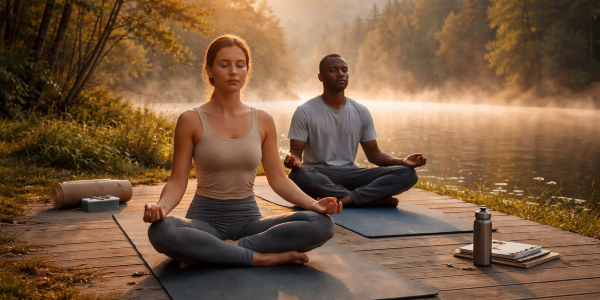
Trauma-informed yoga (TIY) changes the focus. It stops caring about how the pose looks and cares only about how it feels to you. It is built on three main rules:
- Invitational Language: A trauma-informed teacher uses choices like 'I invite you to place your foot here' instead of commands. This gives you back the control that trauma took away.
- No Hands-On Adjustments: In many somatic yoga therapy settings, the teacher will not touch you. Your personal space is yours alone. This prevents the fear response that happens when someone enters your space unexpectedly.
- Feeling Over Looking: The goal isn't to make a perfect shape. The goal is to notice what is happening inside your body like feeling your feet on the floor or your breath.
By creating a safe, quiet space, TIY tells your brain: (Right here, right now, I am safe.)
Yoga Teachers vs Yoga Therapists
As more people look for yoga for healing trauma, it is important to know the difference between a Yoga Teacher and a Yoga Therapist.
A Yoga Teacher usually completes a short 200-hour course. They focus on fitness and group classes. They are rarely trained in how trauma affects the brain or how to keep PTSD patients safe.
On the other hand, a Yoga Therapist (C-IAYT) goes through 800 to 1,600 hours of training. They study psychology and how to use yoga for medical conditions.
A New Standard of Care
Leading mental health providers are fixing this problem. They are putting yoga therapists directly on the medical team. A prime example is Savant Care, a clinic serving California and Texas. They combine medical psychiatry with somatic yoga therapy.
Unlike a gym where yoga is just an extra activity, Savant Care includes yoga therapy as a core part of your mental health treatment. Their motto is simple: ‘Yoga isn't about perfection, it's about connection.’ This approach ensures your yoga practice works safely alongside your medication and therapy.
How Yoga Impacts the Traumatized Brain
We no longer have to guess if yoga works as medicine. Strict studies show that PTSD yoga can actually change the structure of your brain.
Fixing the Stress Response (The HPA Axis)
Trauma breaks your body's alarm system (the HPA axis). In PTSD, this switch gets stuck in the 'on' position. Your body floods with stress chemicals even when you are safe.
It turns out that the slow movement and controlled breathing in yoga send safety signals from your body to your brain. These signals turn off the alarm, lowering your stress levels.
The Vagus Nerve
A key part of yoga for post-traumatic stress disorder is the Vagus nerve. This is the main nerve connecting your brain to your major organs. It controls your ability to relax.
Trauma survivors often struggle to calm down after stress. Deep belly breathing and specific postures stimulate the Vagus nerve. This improves your body's ability to relax.
Clinical Evidence: The Van der Kolk Study
The strongest proof comes from a famous study by Dr. Bessel van der Kolk. He compared women with PTSD using 20-week of trauma-sensitive yoga against a group using only talk therapy.
At the end of the study, it was found that 52% of the women in the yoga group no longer met the criteria for PTSD.
This suggests that for many, yoga can help you get better when combined with other therapies.
Somatic Yoga Therapy
Why do we need to involve the body? Why isn't talking enough?
Traditional talk therapy uses the 'thinking brain' to analyze emotions. But the reality is that trauma isn't stored in your thoughts. It speaks through physical feelings.
Somatic yoga therapy works from the bottom up. By working with the body first, we send safety signals up to the brain. This allows you to process traumatic memories without getting overwhelmed.
The California Connection
This method has deep roots on the West Coast. Somatic yoga therapy in California has set the standard for the rest of the world.
Clinics like Savant Care have expanded on this. They have locations in San Francisco, Los Angeles, San Diego, and Fresno. By offering telehealth options, they make this high standard of care available to anyone in the state (and Texas). This means you can access top-tier somatic therapy from the safety of your own home.
5 Key Benefits of Yoga for Healing Trauma
When used as part of an integrative PTSD treatment plan, yoga offers benefits that medication and talk therapy alone might miss.
1. Lower Heart Rate
Survivors often live with a racing heart and tight muscles. Yoga slows your heart rate and lowers blood pressure. Long exhales signal your nervous system to give you immediate relief from anxiety.
2. Better Sleep
Insomnia and nightmares are common with PTSD. By calming the nervous system before bed with gentle poses, survivors report falling asleep faster and staying asleep longer.
3. Staying Present
Dissociation is the body’s way of checking out when pain is too high. Yoga for healing trauma teaches you to ‘check in.’ By focusing on your feet on the mat or your hands on your knees, you build the skill to stay in the present moment.
Patient Perspective: My experience with both Dr. Machikawa and Riya Bhatt for meditation/yoga has been amazing. Dr. Machikawa has been instrumental in managing my anxiety. And the sessions with Riya are very fulfilling and relaxing - I feel very grounded! — Verified Savant Care Patient, San Francisco.
4. Handling Emotions
PTSD can make feelings feel overwhelming. Yoga helps you handle uncomfortable sensations without reacting instantly. Learning to hold a difficult pose and breathe through it trains you to hold difficult emotions off the mat.
5. Taking Back Control
Trauma is something that happened to you without your permission. Trauma-informed yoga is the practice of taking that power back. Every time you choose to move or not move, you practice self-control.
Finding 'Trauma Yoga Near Me'
If you are ready to try this, finding the right provider is key. A general search for trauma yoga near me or PTSD yoga can give mixed results. You need to check them carefully.
The Insurance Advantage
Cost is often the biggest problem. Most yoga studios do not take insurance. But because Savant Care is a medical clinic, they accept major insurance plans (including Anthem, Blue Shield of CA, Aetna, Cigna, and Optum).
Even better: Clinical Yoga Therapy is included at no extra cost for their patients. This solves the money problem. Your team can get psychiatric care, medication management, and yoga therapy all for one insurance copay.
Questions to Ask a Provider
Whether you choose Savant Care or another provider, always ask these questions to ensure your safety:
- Is this class specifically trauma-informed?’ You should look for RYT-200 or C-IAYT credentials with specific trauma training rather than general fitness certifications.
- Do you touch students to adjust poses? The answer should ideally be no. If they do, they should have a strict system to ask for your permission first.
- Is this connected to my medical care? Your yoga therapist should be able to talk to your psychiatrist if needed. This ensures your treatments are working together.
Red Flags to Avoid
Avoid classes called 'boot camps' or 'power flows.' Avoid rooms that are very hot, loud, or competitive. These are the exact opposite of what they can mimic high stress and make you feel worse.
Frequently Asked Questions (FAQ)
Do I need to be flexible to do PTSD yoga?
No. As the team at Savant Care says, ‘Yoga isn't about perfection.’ Yoga for post traumatic stress disorder is about internal awareness, not flexibility. Many trauma-sensitive practices can be done sitting in a chair or lying down.
Will yoga trigger my trauma?
Moving your body can sometimes bring up old feelings. However, a trauma-informed class is designed to feel safe.
‘I recently started attending complimentary yoga and meditation sessions... I look forward to these weekly sessions with Riya. Her tailored approach, gentle guidance, and patient teaching make each practice meaningful.’ — Yoga Participant: San Francisco
Can yoga replace my medication or therapy?
Yoga works best as an integrative PTSD treatment. It is designed to work with your therapy and medication, not replace them.
The Bottom Line
Trauma leaves a mark on the body, but the body can also heal. The question 'Can yoga help overcome PTSD?' is answered by science and the stories of thousands of survivors.
By doing somatic yoga therapy, you aren't just stretching muscles. You are stretching your ability to feel safe. You are retraining your nervous system to understand that the trauma is over.
Healing takes time. But with the right support, whether through a local studio or a clinic like Savant Care that respects the medical care need for this practice, you can move from surviving to thriving.
Take the Next Step
If you are ready to see how somatic practices can help you recover, you don't have to do it alone.
Book a Free 15-Minute Consultation with Savant Care
Check Your Insurance Coverage for Integrated Treatment
Don't let trauma define your future. Reclaim your body, one breath at a time.
Sources:
- van der Kolk, B. A., Stone, L., West, J., Rhodes, A., Emerson, D., Suvak, M., & Spinazzola, J. (2014). Yoga as an Adjunctive Treatment for Posttraumatic Stress Disorder: A Randomized Controlled Trial. Journal of Clinical Psychiatry, 75(6), e559-e565.
- Telles, S., Singh, N., & Balkrishna, A. (2012). Managing Mental Health Disorders Resulting from Trauma through Yoga: A Review. Depression Research and Treatment. (Supporting the HPA axis and Vagus nerve mechanisms).
- Emerson, D., & Hopper, E. (2011). Overcoming Trauma through Yoga: Reclaiming Your Body. North Atlantic Books. (Foundational text for the TCTSY protocols mentioned).
Disclaimer:
The information provided in this article is for educational and informational purposes only and is not intended as medical advice. Yoga and somatic therapy can be powerful tools for managing stress and trauma, but they are not a substitute for professional medical treatment, diagnosis, or therapy. Always consult with a qualified healthcare provider or mental health professional before beginning any new practice, especially if you have a history of trauma or a mental health diagnosis. If you are in crisis, please reach out to a crisis hotline or your local emergency services immediately.